Friday, December 9, 2011

Bookmarked

One of my favorite repeat conversations I get have with my students is one where I inform them I do not have a television.  (For the record, I never thought I'd be that guy but here I am, four and a half years, without a TV...who knew?)  Their face is classic shock and dismay, usually followed with an exasperated "But, what do you do?!?!"  As sad as some of the psycho-sociological analysis one could apply to the meaning for these students and society at large, I just think about all the free time I have for other things.  Namely, reading.
As an adult, reading whatever I please, I have finally learned that there is no shame in quitting a book.  It took almost thirty years, but I figured out that you don't get in trouble and the earth keeps turning.  I imagine my life would have been a lot different had I applied this philosophy in high school.
This has been an excellent year for books and I thought, with all the "year end" lists abounding, I would do my own.  So, here are the books that I thought were worth finishing that I read in 2011:

Await Your Reply - Dan Chaon
This was one of the only books that I became more disappointed with as it progressed.  Now, it was still good enough to finish, and, ultimately, the author hurt himself with his excellent writing skills with such an intriguing and compelling opening sequence.  Or sequences.  The book is actually three stories which may or may not be related.  Each one is captivating unto itself and you almost forget how much you enjoy them individually when one chapter ends and you flip back to another storyline.  Usually plots like this drive me nuts as I often read in short spurts - bus rides, bank lines, etc. - but it has a driving storyline and therefore was a fast read.


This Is Where I Leave You - Jonathan Tropper
Equal parts humor, heartbreak, and awkward silence, this story of a grown family brought back together to "sit chiva" (the Jewish tradition of mourning a loved one) for a week is about as real as contemporary storytelling can get.  The characters are great, in all their messed up ways, and the narrator is not excluded from this.  Aside from having just lost his father, who he wasn't that close with, he is recently separated from his wife after she cheated on him, not to mention he really only speaks to one of his four siblings.  The perfect combination of a sitcom and a car crash that you can't take your eyes off of, this novel had as many enjoyable bright moments as enjoyable dark ones.
"The thing about people who work in finance is that they consider their job infinitely more important than anything or anyone, and it's perfectly legitimate to tell everyone else to f*** off because they have a conference call with Dubai. If Barry was sitting next to the president of the United States during a nuclear attack, he'd still be staring down at his BlackBerry with his default expression, the one that says 'You think you've got problems?'"

Island Beneath the Sea - Isabel Allende
I'm not a huge fan of historical novels and historical fiction usually doesn't entice me, but this book, by famous Chilean author Allende, translated from the original La Isla Bajo el Mar, was incredible - probably my favorite on this whole list.  Through it, the story of a fictional young slave - we meet her as a child - and the real life story of the present day island that holds Haiti and the Dominican Republic is told.  More importantly, and mostly unknown, is the fact that this is the scene of the first and only successful slave revolt and subsequent revolution in the New World.  The story covers many years, countries, and characters.  Whether real or fictitious, each is rich for the page in the way their role in the infamous events that followed unravel.  I highly recommend this book and plan to read more from Allende in the future.

The Hunger Games / Catching Fire / Mockingjay - Suzanne Collins
        I got sucked into this trilogy before I even knew what happened.  I never jumped on the Harry Potter bandwagon, didn't give the Twilight series a second look, and tried and failed to get into the Dragon Tattoo Girl who kicked stuff.  I've been secretly itching for a popular series.  The wait was worth it.
        It is technically Young Adult Lit so I admittedly was able to cross all three books from my list in about a two and a half week period.  Regardless of the heavy foreshadowing, impossibly constant chapter-ending cliff-hangers, and a premise that will make me sound crazy, there is a reason these books are so popular amongst the pre-teen (and teen) set.  The idea that a future society exists where children are annually put into an "arena" in a fight to the death as a means of governmental control, is mockable.  But when this same book is appearing on legitimate middle and high school reading lists or required novels due to the social, philosophical, and political discussion they can generate, I'd say its a book (series) worth checking out.  I know I am personally responsible for at least three people becoming anit-social book-addicts for a few weeks.  Also, how much more fun will the March release of the first movie be when you and all the "tributes" are already on a first-name basis?!?


The Absolutely True Story of a Part-Time Indian - Sherman Alexie
Also, considered Young Adult Lit, this is the semi-autobiographical story of an Indian boy in Washington state who makes the bold decision to attend school in the nearby town and not on the reservation itself, where his entire life is.  Thus begins his high school experience where he is marginalized by the white townies and seen as a traitor by his reservation community; he is essentially ignored in both worlds he now exists in.  A commentary on tolerance, race, culture, and prejudice, this National Book Award winner is fast, interesting, and surprisingly funny and self-effacing.   The tone sounds and paces itself just like a precocious teenager's journal would, and the occasional doodles and illustrations accentuate this sense perfectly.


Aunt Julia and the Scriptwriter - Mario Vargas Llosa
Vargas Llosa is arguably Peru's most famous contemporary writer and there's a reason for that.  As long as this book took me to finish - due the density of each page, not being bored or finding it tedious - it was one of the most fantastically crafted stories I've read in a long time.  The story centers around a young law student moonlighting as a news copy-editor at a radio station in Lima, Peru.  He has recently befriended the bizarre scriptwriter for the station's wildly popular serials and been introduced to his "aunt," whom he enters into a secret illicit love affair.  (It should be mentioned that this woman is the sister of his real aunt, not a blood-relative.)  As the story progresses the chapters alternate between the aforementioned relationships and the radio serials themselves.  This was a little confusing the first few even-numbered chapters, especially when you're introduced to a new set of intriguing characters only to leave them at the end of an often unfinished cliff-hanging storyline.  As the novel progresses and the titular scriptwriter begins going mad, the stories do too, combining characters, resurrecting supposedly dead ones, or confusing their jobs or pasts.  The novel also never loses its charm or momentum; in some ways, it even seems to gain it.

The Language of God - Dr. Francis S. Collins
Written by one of the leaders of the monumental Human Genome Project, the book makes a case for the essential co-existance of God and science.  Collins, an ex-agnostic/atheist, is one of the few successful and renowned biologists in his field who is also a proud Christian.  Often receiving criticism for his faith from colleagues, saying that being a biologist/scientist and a believer is a serious conflict of interest, he sets forth with this book to justify that this is not the case.  Without evangelizing or name-calling, Collins does an impressive job of categorically knocking down or casting significant doubt on many oft-used anti-diestic arguments, as well as providing a sort of spiritual memoir.  Whatever your views, this is an enlightening, well-written [long-form] essay that will make you think...even if, like me, you don't understand a thing he says about astrophysics.

What is the What - Dave Eggers
A few years ago I read a good book about the "Lost Boys" of Sudan.  Those, often very young, non-Muslims in the population forced to walk unfathomable distances across an unforgiving landscape for survival.  That book was called They Poured Fire On Us From the Sky and was written by three such now-grown "boys."  This novel, however, though autobiographical, written in first person, and centered on around an actual individual is authored by the incredibly talented, Dave Eggers.  Valentino Achak Deng was a very young boy when his Dinka village was attacked by Arab militia, killing many, including, he presumes, his mother before his very eyes.  He has an unfortunately typical tale: walking for what amounts to years, living for more in various refugee camps, surviving on what amounts to table scraps for food, and eventually arriving in the US and adapting to a new culture.  What Eggers does masterfully, however, is weave Deng's current life in Atlanta with flashbacks to his unfortunate childhood.  What could have been a straight forward chronological telling of a tragic story, suddenly becomes a highly textured tapestry that is difficult to put down.  If you're going to read one book on the plight of Sudan, make it be this one.
"Have you ever seen [your mother] terrified?  No child should see this. It is the end of childhood, when you see your mother's face slacken, her eyes dead...when she does not believe she can save you."

Everything is Illuminated - Jonathan Safran Foer
I ended the year with a book that I've read before; it is one of my favorites!  Safran Foer is one of those talented writers that does not seem to believe in the traditional rules of crafting a story, nor of what can be done on the page itself.  This novel is a fairy tale of sorts; it takes an intriguing story and twists it into a fanciful journey through multiple narrators, time periods, and forms of communication.  The basic plot centers on a Jewish-American, also named Jonathan Safran Foer, who travels to the Ukraine to search for a woman who helped save his grandfather from the Nazi's.  Unfortunately all he has is an old photograph, a name, and a town.  He also has enlisted the help of a young translator, named Alex, who's grasp of the English language is limited, endearing, and comical; his grandfather, who won't let anyone else drive his car; and Sammy Davis Junior Junior, his grandfather's seeing-eye dog.  If that is not a recipe for a great story, I don't know what is!

Is Everyone Hanging Out Without Me? - Mindy Kaling
Earlier this year I read (most of) Tina Fey's memoir, Bossy Pants, which was interesting and definitely humorous, however, not engaging enough for me to finish it, thus it's absence from this list.  Kaling - better known as The Office's Kelly Kapoor - has done what Fey didn't: write like a comedian.  Just like a stand-up act or a sketch-comedy show, Kaling keeps her topics short and sweet, switching topics like an ADD, ritaline-addled toddler.  Even the chapter titles will bring a smile to your face; "Don't Peak In High School," "The Day I Stopped Eating Cupcakes," "Revenge Fantasies While Jogging," and "Why Do Men Put On Their Shoes So Slowly?" are only a few titular gems.  Yes, it is brainless fluff, but Kaling herself is nothing but intelligence and drive.

Thursday, November 17, 2011

A Mother's Earth

In the era of global warming, environmental awareness, sustainable practices, and recycling, teaching ecology takes on a whole new form.  It is hard to argue against the fact that education is paramount in affecting awareness and change.  This year I had the unique opportunity to take my class of Pre-AP Biology students, all 11th graders, to a self-sustaining eco-community located about half an hour outside of Cali.  While many of the ideas and ways of life implimented in this community - which includes about forty families and is governed entirely by women - are a little unrealistic for a contemporary lifestyle, I feel it is important for my students to see how thinking "outside the box" can, indeed, work.

Nashira, named after an indigenous goddess of abundance, uses solar energy for many of its power needs, including all the cooking.  All of the buildings have been constructed using recycled materials to create the "cement" and composting sheds have been set up throughout the commun for equal access for all the individual gardens set up in each family plot.  Each family is assigned and responsible for the opperation of one aspect that the entire community benfits from, for example the raising and collecting of hen and chicken eggs, the maintainence of the compost sheds, organizing the recycled and waste materials in the materials building, to name a few.

One the most ingenious aspects of the community is the main communal bathroom, called a baño seco or "dry bathroom" as it is flushless and requires no traditional plumbing.  This is not your average hole in the ground toilet, however!  The toilet bowl is separated into two sections, for number one and number two, respectively.  After doing number two, all that is needed is a scoop of dirt from the handy dirt container located next to the trash can.  This goes into a recepticle apart from the urine and can be used as fertilizer, along with the toilet paper that is disgarded here as well.

My students had a great day and seemed to be really inspired by human ingenuity.  After taking a guided tour of the community, doing two different workshops on waste disposal and making new paper out of recycled paper, and having a delicious sancocho lunch cooked by solar power, we were all justifiably exhausted but also ready to bring some of these ideas back to school and to Cali. All in all, it was successful trip!

My Pre AP Biology class.

Reduce, Reuse, Recycle!

Waste management workshop
Recycled paper-making workshop


Tuesday, October 25, 2011

Coffee Country

With the heat of Cali, it is occasionally nice to retreat to a cooler locale, somewhere where a hot cup of coffee, agua panela with cheese or a hot chocolate can keep away the mountain chill.  I've been to much of the eje cafetero (coffee region) before and have come to know it as a fantastic reprieve from the bustle of Caleño city life.  Its proximity of about three to four hours by bus is also agreeable. During a recent long weekend I traveled there yet again with some friends to the colonial town of Salento and then on to some natural hot springs outside the town of Santa Rosa de Cabal.


Homegrown coffee on a lazy, rainy afternoon.
Countryside surrounding Salento.
Salento nightlife.
At the hotsprings in Santa Rosa.
San Miguel waterfall above the hot springs.
Along the way we enjoyed many of the local foods and novelties of the paisa region including very fresh coffee, buñuelos, river trout, and my personal favorite: bandeja paisa (say: ban-day-ha pie-sah).  This hearty meal consists of beans, a pork rind, an avocado wedge, an arepa, fried plantains, rice, a shredded lettuce salad, and some sort of meat - usually chicken or beef, but sometimes fish or sausage. It is also not uncommon to get a fried egg plopped right on top of it all.  The best part of stuffing yourself with this plate at lunchtime is that you will be full for the rest of the day and all for the incredible price of $3-4 USD!

The bandeja paisa in all its delicious hearty glory!

Monday, October 10, 2011

I Smell A Rat

Two tea boxes on the floor, a jar of honey in the sink, onion salt shaker resting sideways on the counter, kitchen cupboards hanging wide open with a bunch of spaghetti noodles falling out of their bag, extending precariously over the shelf ledge.  After a particularly long day Friday last, I arrived home to my apartment to find the kitchen in a strange state of disarray.

After eliminating the possibility of an intruder who likes to make messes in cabinets and leave, I began to suspect the visit of an animal of some sort, possibly a bird.  That hope was quickly dismissed upon pulling open one cupboard door and finding a rat the size of a small child peering out from behind my wine glasses.  Doors were slammed shut, an old mop handle was inserted through the cabinet pulls, and some masking tape haphazzardly applied for good measure; this would be dealt with in the morning.

***
The biggest rats I've ever seen have been the ones that roam Isla Gorgona and the back alleys and subways of Chicago.  Secretly hoping my own comprably-sized rodent intruder found its own mysterious way out, I went about "unlocking" the cupboard doors.  After momentarily believing my wishful thinking had come to fruition, I found it lurking behind the wall of tea boxes.  Plan B: Block off the kitchen so the only way of escape is through the patio doors where there is actually no escape and I can either sequester it outside and/or chase it around swinging violently with the aforementioned mop stick in an enclosed space.

I should mention that there is a fuse box located on the back wall of the kitchen cabinets.  This was part of my hope when I wished for the possibility of a spontaneously disappearing rat.  I have no idea where or even if this fuse box has some sort of outlet - construction codes are somewhat open to interpretation here - that rats, for example, could use to come and go as they please.  This rat decided to try, or at least avoid my mop handle, and hide in the fuse box.  For awhile the rat was winning the battle; no matter how much I prodded and banged around, it seemed to find a way to not only avoid contact with the stick but also not feel an urgent need to flee toward the patio as I had intended.

And then the rat unceremoniously layed down and a strange odor filled the morning kitchen air.  New problem: How do I extract a large electrocuted rat from the fuse box in the back of my kitchen cupboard?  After some creative maneuvering, with the help of a clothes pin and a plastic bag, I am happy to say there is no more rodent habitating in amongst my dinner plates and spices.  Although the stench of singed rat did hang in the air for awhile...

Saturday, September 17, 2011

Un-Break My Heart

An Open (Formally Love) Letter to the MIO

Dearest MIO,

On this weekend of Amor y Amistad I had full intentions of writing you a love letter.  You would be my Colombian Valentine.  I had composed this thought months ago.  I love your efficiency, your cashless cards, your recharge booths, your air conditioning, your cleanliness, your two stops located oh so near to my house in either direction blah blah blah...no more.

I revoke my intent to make you my Valentine.  For the record, we are no longer "in like;" we're irritated and fighting.  ("In love" you ask?  Ha! Amigo, don't even get me started!)

How did this happen?  Well, maybe you can tell me.  How about when you decided that everyone loved you so much that you could stop being considerate of all the commuters that depend on your services on a daily basis.  I appreciate the fact that you are constantly evolving, adding new routes and adjusting old ones to better accommodate your passengers' needs.  In the past, however, you used to care.  You used to announce changes.  You used to change your signs and maps.  You used to update your website for crying out loud!  (Your website used to care too.  You both should be ashamed.)

Let me take you back a few days to last weekend.  I entered the Buitrera station and waited for 20 minutes for the P14 bus to take me home.  After a super-human amount of patience I asked one of your guards if the P14 was running that evening.  He seemed [very] surprised that I was unaware that the P14 "doesn't exist" anymore.  Dearest MIO, he acted as though I were asking of the whereabouts of the lost city of Atlantis, not a bus route that had been unceremoniously dumped a mere six days prior.

No, you didn't even have the courtesy to take down the little oval signs indicating which doors the bus will pull up to or post a note on the maps adorning your walls, indicating a changed route.  Some of us - I'm aware you have other lovers - might only use a particular route once a week.  Granted, your guard did inform me that they made an announcement of some sort - yelling perhaps? - on the Monday the change was made.  Thankful are those riders who were fortunate enough to have been standing within earshot that morning in the station, I'm sure.

Yes, I can take the newly created P74A and get dropped at the same spot.  But, MIO, I would rather not have to take two buses, the later of which I have to leave the Capri station to get on, for a relatively short ride home.  At least the P10A is still in existence; unless you decide to break my heart twice in such a short period of time.

I should tell you this also, MIO.  Just yesterday I was waiting in the Universidades station, the terminus of your Troncale and most southern routes.  Looks like your signage is still misleading us; seems I could wait infinitely for the P14 from here too.  Map?  Check.  Overhead sign?  Check.  Oh, what is this?  A bus labeled P14A has just pulled up?  I wish I could consult a map and find out where this goes.  I hope no one gets on and ends up in some forlorn part of town.  I decide in this moment to check the website when I get home to find out where this deceivingly similarly named bus will whisk these people off to.


Dearest MIO, update your damn website!  Don't lie to me either.  Look at this screen shot from today, Saturday, September 17th - supposedly a day we would share our love and friendship with each other.  Seems you're living in the past MIO.  Get over yourself.  I am.  Maybe I'll just go ahead and figure out the messed up world of your dirty cousins: the Recreativos, the Ermitas, or the Blanco y Negros.  Think about how you'd like to see me staring back at you from their filmy windows, huh?

Think about it, MIO.  Think about that.

Sincerely,
Sergio

Tuesday, August 30, 2011

Now That You Mention It...

Remember the scene in Pretty Woman when Julia Roberts is shopping for something nice to wear in a fancy little boutique somewhere on Rodeo Drive and the shop girls follow her around the store, making rude comments and passing judgement, despite the fact that she has money to burn?  Shopping in a Colombian mall will make you feel like Julia Roberts, but minus the rude comments and judgement passing.

It has been something all of us gringos discuss from time to time: how annoying it is to visit a store, whether to browse or to buy.  We try to be strategic and make up our own set of rules.  Never enter a store void of other costumers.  Check the ratio of shoppers to customers from the entryway before entering (Sub-clause: leave if ratio decreases to levels not in your favor.)  Only go shopping with a friend and then, once past the threshold, divide and conquer; they can only follow one of you at a time, right?

Now, if you're a fan of having your own personal shopper, then this is the country for you!  Touch an item just briefly and the sales person has it off the shelf/hook/hanger and is presenting it to you in all it's glory.  Need a specific size and it will materialize faster than you can say "dressing room."  However, if you like a nice leisurely trip to the mall, you're out of luck, amigo.

Today I stopped into my local Adidas store to check out some of their running apparel.  I realized this was going to be "one of those" visits when, no more than two steps into the store I was greeted, asked what I was looking for, and told that this gentleman was "at my service."  After exchanging pleasantries and informing him that I was "just looking" he, not surprisingly, proceeded to trail me as I weaved in and out of the store's aisles, making conversation and pointing out various things along the way.  "This one is nice. These and new.  Do you like this?"  And so on.

Again, this is typical of a store clerk and the shopping experience in general.  However, this gentleman did something different: he asked me how the retail service was in the U.S.  (I'm sure a giddy smile appeared on my face.)  Well, if you really want to know...  I told him it was very good and that people are friendly and greet customers, but that they don't "follow them around the store."

And...release; it was like going to therapy.

Of course, he just nodded thoughtfully, continued to stay near me for the next few minutes as I browsed my way to the exit, and explained that "in Colombia it is good service to always be helpful and attend to a person before they have to do it them self." Thank you, sir, I'm aware.  At least I told someone.

Thursday, August 18, 2011

Hometown Glory

Orchids
One of my good friends here in Cali, Beatriz, is from a smaller city about five hours north by bus, along the eight-hour journey to Medellín.  Ever since we first met several years ago, I have heard about this "beautiful city" and, despite several failed attempts, we were finally about to organize a weekend to make the trip to get to know this city from an insider's perspective.

Manizales, the capital of the Caldas department (state) is located in and amongst rolling green hills and valleys in the mountains of Colombia's coffee region.  The people of this area are known as Paisa's (say: PI-sah), and are often compared with Texan's and the Quebecois in that they are a proud and friendly people with more local pride than national.  (It should also be noted that the unofficial stereotype of the Paisa's is that they have terrible hairstyles; it sometimes seems like everyone is in a punk band.)

Beatriz explaining the history of Manizales as told by an
elaborate and impressive hilltop scupture.

Bolívar statue
We did the typical visits to popular tourist sites in the city - the main cathedral, a statue of Simon Bolívar as a bird, a watertower turned into cafe/nightclub/climbing wall, and an eco-park just outside of town filled with orchids, hummingbirds, and a zebra and ostrich rescued from a narco-trafficer's private collection - but the most interesting place was in the "zona rosa" of the city, a neighborhood known as Cable.  Situated atop a ridge, the strip of restaurants, bars, cafés and clubs is the place to be almost every night of the week.  Aside from the people-watching, what made Cable so intriguing was that Manizales - especially at night and on a summit - is cold and there were people everywhere outside.  For comparison, Cali is universally hot and there are not nearly as many outdoor dining areas in the entire city as there were in this one area (I may be exaggerating slightly, but you get the idea).

One of the things I will always associate with Beatriz is her disdain for the hot chocolate served at school for breakfast on Friday mornings, always bemoaning the fact that the chocolates are so much better in Manizales, as she wrinkles her nose and refuses to take one.  This too proved to be true.  As did the fact that ordering an empanada or a bandeja paisa (huge plate of beans, lentils, meats, a potato, fried plantains, and one fried egg) outside of the region pales in comparison and would only serve the purpose of attempted nostalgia.

Hana, Jennifer, Nira, and I at El Mirador in Manizales
Between the scenery, the people, and the food, I count this city as one of those magical places one goes to disappear without ever hiding.  Should I ever vanish on my own accord, place Manizales as one of first places to look for me; I'll be happy to show you around!

Tuesday, August 9, 2011

Kicking Things Off

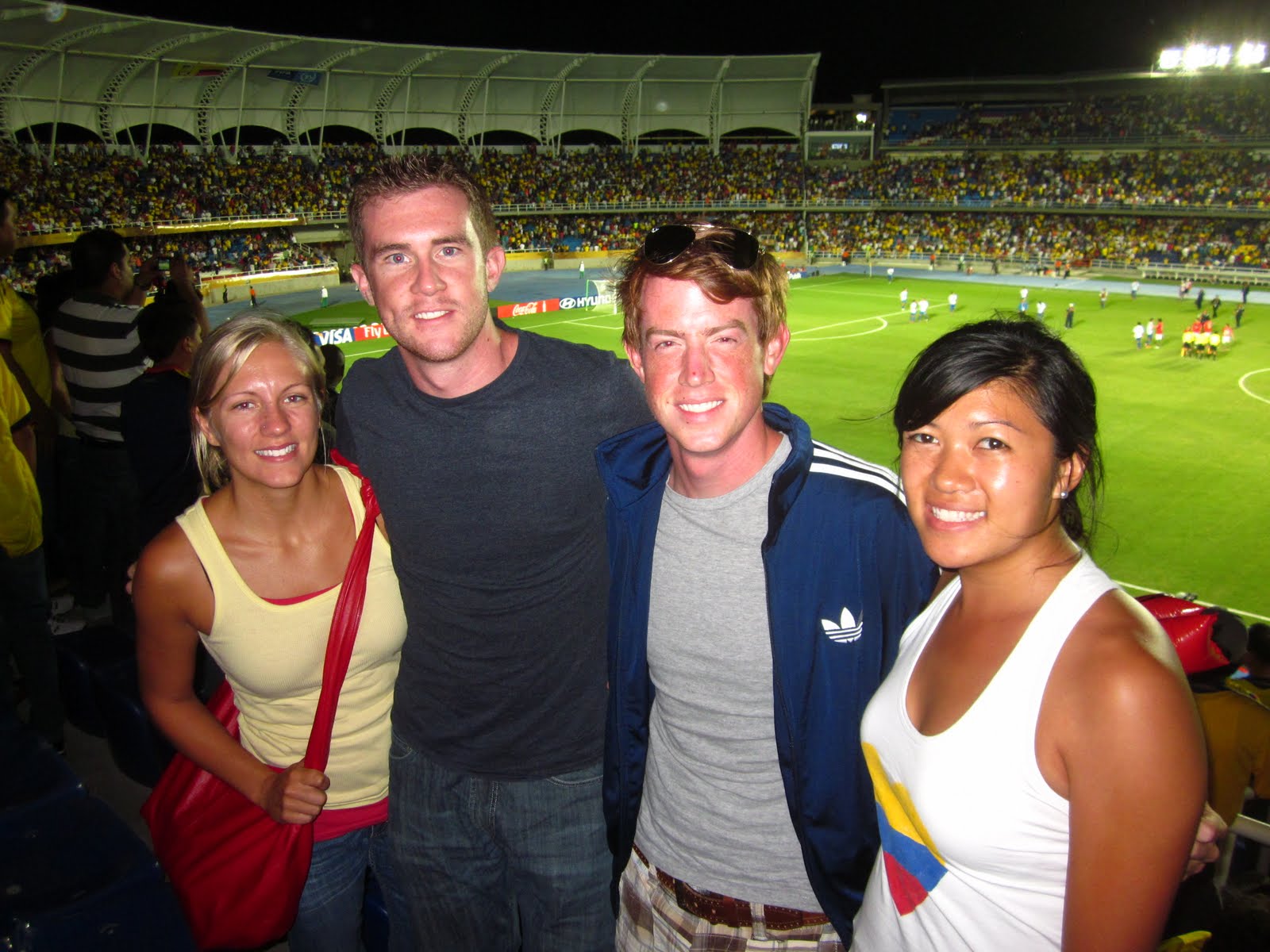
Last summer the world - most of it - was engaged in the FIFA World Cup Soccer tournament hosted by South Africa and singing along with Shakira to a little ditty called "Waka Waka (This Time For Africa)".  A short month ago, things were repeated in Germany with an epic showdown between the USA and Japan for the title of the FIFA Women's World Cup final.  Well, low and behold, I arrived back in Colombia to the start of the semi-final round of competition for the Copa Mundial Sub–20 (U-20 World Cup tournament), with games hosted in cities all over the country!

Rita, Rob, Samantha, and me, after Portugal's vistory.
This afternoon a few friends and I had the privilege to attend the semi-final match between Portugal and Guatemala right here Cali in the newly renovated stadium downtown.  Portugal won 1 - 0 with a penalty kick early in the first half to advance to the quarter finals.  There was so little action the rest of the game that the fans around us started called the losing team "Guatemalo" (malo = bad).

Afterwards we headed to a nearby bar to watch Colombia take on Costa Rica live on television.  The game was being played in Bogotá, but most of the fans at our particular watering hole were decked out in full Colombian soccer regalia.  It was a close and tense match ending with a national victory 3 - 2.  As I sit in my apartment now, there are still horns being honked several blocks away near the bars and clubs that are open celebrating.  I'm looking forward to the craziness if they advance even farther!


Sunday, June 26, 2011

I'm On A Boat

Coincidentally, all of my vacations this past year have been to coastal areas where swimwear was required attire.  From the jungle area of the Chocó to the Caribbean island of San Andrés to the coastal desert department of La Guajira, I figured it didn't make sense to break from tradition.  The week following the end of school I packed my board shorts and headed with a small group of teachers and some of their visiting friends on a kayaking adventure along the Pacific coast.


Departing from the only large urban area on the Pacific coast, the port city of Buenaventura, we took a fiberglass lancha to the small fishing community of Juanchaco, which served as our base camp for the next three days.  Our guide, Julio, runs his own ecotourism business and trips like this are his life, so we were in good hands.

Admiring the orchids.
Over the next three days we enjoyed mostly sunny weather - unusual for the Pacific coast, which is one of the wettest places on the planet - with visits to the small islands off the mainland, some caves, secluded beaches, an estuary, and river going into the jungle.  We saw bats fluttering about in caves, crabs scrambling over wave-swept rocks, pelicans roosting in trees, and blue-footed boobies perched precariously on cliff ledges.  Julio also was fond of pointing out all kinds of species of orchids, which happens to be Colombia's national flower.

Boobies!
Ocean kayaking is strenuous, especially when your fighting the current or getting nauseous from large sea swells.  Despite the sore shoulders, near-blistered hands, chaffed butt, and one capsizing, nothing can compete with the stunning beauty of this region, especially sections only accessible by small boat.  With Julio's expertise, I will definitely be doing this trip again!

Friday, May 13, 2011

Trivial Pursuit (Part II)

A little over a month ago, I took the ICFES, Colombia's version of the SAT.  This morning the results were posted online.  While the scoring is complex with many subscores and sub-subscores and socres that are essentially dependant on how the rest of the testing population fared, I feel pleased with my results.

There are 1000 "puestos" or spots and everyone is ranked into one of those.  I ended in Puesto 683 which is about 31.7%.  Not too bad when the majority of my competition has native fluency in Spanish and is not ten years out of graduating from high school.

Of the individual subject scores, I got a 91.7 in English language - its a joke - and my next highest was a 58.9 in Biology, thankfully.  Now, in order to apply to most Colombian universities, I am told, any score over 50 is considered acceptable.  My Chemistry and Math scores were also in this acceptable range.  I knew nothing of Philosophy and it showed with a score of 12.7, however, the one I'm most proud of is the "lenguaje" section, which is dealing with the Spanish language, but in a Language Arts context; I got a 45.3.  Not to bad for someone who didn't know a lick of Spanish less that four years ago!