Wednesday, March 16, 2011

Total Immersion

When I first moved here I knew no Spanish whatsoever.  Mentira, I knew how to count to ten, say holacerveza, and ask the way to the bathroom by saying baño and pointing.  The rest was just fun little adventures along the way.  Talking to taxi drivers, the cashier in the grocery checkout line, the man who runs the copy machine room at school; basically, if people would talk to me, I would talk with them.

I enjoy going to movies, especially here where they are cheaper than in the US and have assigned seats.  The good dramatic fare doesn't always make it here and when it does one must be quick to catch it before it is off the marquee forever.  Most of the time what arrives here is slap-stick frat-boy comedies, cliché chick flick rom-coms, or cartoons.  I can't judge - I go and see them anyway, thus etching my "movie snob" title deeper in stone.

I crossed a milestone this year, however: I've seen two movies in Spanish, therefore without sub-titles of any kind, and understood most of what was going on.  Except for cartoons and other kid-friendly films, the rest are all subtitled in Spanish.  In previous years I've seen other foreign language films and gotten through them by reading the Spanish. (Reading comes easier to me for some reason than listening, perhaps due to a lack of dialect.) "La Vie en Rose" and "Entre les Murs" were slightly easier with my once decent French skills, while "Die Welle" in German was a bit of a head trip, but my brain survived.

Last month I went and saw the Colombian remake of the Robin Williams comedy "RV: Runaway Vacation" called "El Paseo" about a semi-dysfunctional family from Bogotá taking a roadtrip to Cartagena and their misadventures along the way.  In this particular film I had a hard time understanding the mother but, aside from a few slang terms, following the story was fairly easy and enjoyable.  I was also pleased when I laughed at jokes with the rest of the audience.  Score one for the gringo!

Last night I went to showing of a recent award-winning film at several international film festivals in Rome, Spain, and Chicago, called "Los Colores de la Montaña".  This drama takes place in a rural mountain community in the paisa region, so it is rugged, agricultural, and has breath-taking vistas wherever you turn.  It was also the scene of much paramilitary action, which is what the story is based around - how the influx of paramilitary presence affects the residents of this quiet community, the children, their school, their friends, and their parents.  It was a sad and ultimately tragic story, but one that is all too true and, thus, important to tell.  Coincidentally, I had a difficult time understanding the mother in this film too!  Fortunately, she is not the main character; that task falls on Manuel, the nine year old boy trying to figure out what is going on with his once peaceful village.  (The English-subtitled trailer is embedded  below this post.)

If you can find either of these, obviously with subtitles, I would recommend seeing them.  If anything, you can get a better sense of the stunning countryside I get the pleasure of seeing every time I travel.  Two other Colombian films worth checking out are "El Vuelco del Cangrejo", set in the poor Afro-Colombian Pacific region, and "Los Viajes del Viento", a beautiful story set in many places along the Caribbean coast.

Colombian cinema is an up-and-coming force to be reckoned with.  I'm just glad I'll be able to understand it!

Sunday, March 13, 2011

Having Value

Last week I held my eighth round of parent/teacher conferences since coming to Colombia.  Since the inaugural round of conferences my first year here, my Spanish has improved greatly and I have little hesitation giving compliments, offering positive feedback, and discussing goals.  Even "bad" conferences are easier than before - especially when the parent is on my side!

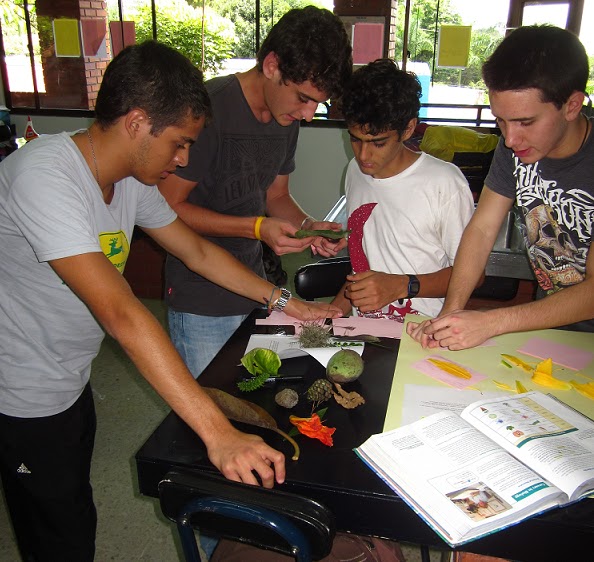
Grade 9: Working with "alleles"
However, something a new colleague said to me during a break in the day struck me.  She questioned how or what these parents did for a living that allowed them all - we have near 100% attendance during the two days devoted to conferences - to leave work and sacrifice several hours of their day walking around campus and talking to eight different teachers.  Sure, some of our families are financially well-off and are either at the top of a company, executively speaking, or run their own businesses, thus being their own boss and setting their own hours.  But not nearly all of them!  And yet they all find a way to show up, dressed as if they simply walked away from their desks elsewhere.

I'm sure their are some deeper, more complex sociological factors at play here and I'm not willing to dive into those at the moment. (The idea that educated people support their children more than less-educated people, and that this is a private school versus a public one so the parents want to see where their money is going both work in here I'm sure.)  In the end, though, I think that education is simply valued more.

With the recent current events going on in the U.S. regarding education and the powers that be that fund and support it, it is an interesting topic to examine. (Those links in the previous sentence don't even cover Wisconsin!)  I feel as though people in the U.S., parents specifically, say they value education, but in reality its like telling a four year old that Santa Claus is real; you almost have to say that.  As the old adage goes: actions speak louder than words.  Except for this Tampa Bay mother:


The truth is, other cultures value education more than the collective entity of the U.S.  Ironically, high school graduates from all over the globe clammer for a chance to study at a U.S. university, despite the constant budget cutting and "what's the point?" news and rhetoric of those saying college is less about academics today than it is about socializing.

Pre-AP Biology: botany scavenger hunt
So, why am I stuck sitting talking to parents - mostly two a time - for two consecutive days, twice a school year during regular business hours?  How have these parents been allowed to walk away from their jobs, sacrificing several hours of their respective companies' time to visit their childrens' teachers?  In my head I imagine a different type of boss with a different type of bottom line.  In my head the dialogue goes something like this: "Sir, I have my son's parent/teacher conference scheduled for tomorrow at 9am..."  "For your son's education?  Certainly!  Take the whole morning if you have to!"

But maybe it's "family" that is actually being valued here.  In my ideal little world though, when your family is being schooled, there are some residual effects and, if one is valued, so is the other, even if by catalystic default.  I don't think as many people in the U.S. would answer as quickly and adamantly that the "family" is held in high regard as they would claim "education" is.

Regardless, I have yet another reason to enjoy teaching internationally.  When I sit with a student's family across the table from me - regardless of the meeting's tone - I feel respected for what I do on a daily basis.  I feel valued.

NOTE:  If I have presented the idea that, while teaching in the States, I felt under-valued or disrespected in any professional capacity, I did not.  I am simply generalizing on the perceptive state of education in the U.S. from a now outside point of view.

Saturday, March 5, 2011

Some Friendly Competition

Every year around this time I get to combine two of my favorite things: competition and school spirit.  The Copa de la Amistad (Friendship Cup) is a soccer match between the two biggest bilingual schools in Cali - Colegio Bolívar and the British school, Colombo Britanico.  Hosting responsibilities switch every other year and this year we made the short hike a few blocks away to visit their campus.  The game can be likened to a North American Homecoming football game, if everyone in the stands actually liked football and weren't there just for the event itself.  Obviously, soccer (the real football) is obsessed over which takes watching the match to a whole other level.
The team takes the field.
The team captain (and one of my Pre-AP Bio students) doing his thing.
11th graders at the match.
Try holding class the hour before the game... F for fail.
Blue and White filling the bleachers
Some of the upper-classmen on the team brought a jersey for me to wear.
In the spirit of "friendship" there are no penalty kicks or shoot-outs so the game can conceivably end in a tie, which it did at one a piece.

Sunday, February 20, 2011

Group Hug!

In Colombia there is a word used to describe an event where people come together in unification.  In the U.S. we might refer to it as a "group retreat" or possibly a "team-building conference."  Here it is called a convivencia (literally, "living together").  Since the 9th graders I teach lost the privilege to go for a week to Isla Gorgona due to irresponsible behavior by many during a similar event as 8th graders and several incidences this current school year with theft and poor treatment of substitutes, it was decided several days away from school with the teachers in an isolated environment to work out some class issues, might be a positive thing.

So, off we headed to a finca ("farm") in the department of Quindio in the heart of the coffee region for two days and nights of "living together."  This region is popular for other trips by our school as the weather is normally comfortable and it is relatively close - about three hours by bus.  During this time the students attended a several workshops by either us or a couple of outside psychologists about team-building, confidence, responsibility, and inclusion, among other themes.  While the dividends of the experience are yet to be seen, I think the trip accomplished one major feat: it humanized some of the teachers for the students, and possibly vice versa.

The event flew by but we still found time to enjoy the space we were in which included several nice pools, a stream with a small waterfall, and a bonfire.  While its no whale-watching, snorkeling, or coral beach, it was a nice break from the daily school grind.

At my "empathy" workshop: Camila, Maria Paula, & Isabella
Nicolás at the "empathy" workshop.

Los Muchachos: Sebastián, Juan Camilo, Rodrigo, Andrés,
Henry, Lucas, Pablo, Juan Camilo, Luis, & Nicolás
How low can you go? Picking up a cut-off paper bag with
no hands and only your feet touching the ground
New challenge: How many 9th graders can you fit in one pool?
Welcome to the Quindío countryside.
Taking a dip in the stream near the waterfall.
Las chicas y la chorrera
(Andrea, Catalina, Juanita, María Antonia, Isabella, & Laura)
Singing at the bonfire...probably Miley Cyrus or Taylor Swift
(Note: Some kids using their BlackBerries to follow the lyrics.)

Wednesday, February 9, 2011

Double Vision

Upon returning home from work yesterday I encountered my downstairs neighbor and her teenage daughter sitting on the ledge outside the front door to our multi-unit house.  They only moved in around October and with our schedules, I hardly ever see them.  Hear them, yes, but a physical sighting is rare.

In fact, the first time I met the entire family was when I returned home near midnight after a Halloween party dressed all in black, carrying a feather boa, hair spiky and sprayed silver, and with black rings painted a good two inches around my eyes.  (In the interest of full disclosure, it was also Grandma, some cousins, and probably a handful of aunts and uncles too.)  Needless to say, we don't have an intimate neighborly relationship.  I probably know their maid best; I seem to run into her during the inexplicable weekly routine of mopping the driveway.

So, despite it being February, asking about each other's Christmases and vacations was acceptable conversation.  After it was established that we both indeed had a pleasant end to 2010 and like spending time with family, the mother asked how my roommate was.  This would have seemed a mundane question, except for the fact that I've lived alone the last two years in Colombia; I have no compañero.

At first I thought, despite the use of the masculine, that she was referring to the third occupants of the house - a woman and her university-aged daughter - whose door is next to mine on the third floor.  No, she ascertained, as she looked to her own emphatically nodding daughter for reassurance, the other guy who lives with me.  Finally believing me that there is no one coming and going from my apartment but me, she turned to her daughter, shrugged, and rationalized, "well, all you gringos look alike!"

I'm not sure how to take this as I always have thought of my hair color as setting me apart from the rest of my pale counterparts, but, as I climbed the stairs, I began to wonder if I looked dramatically different each time I left the house to create the impression that I was multiple people!   I suppose I shouldn't put much thought into it seeing as how a woman who makes her maid wash places her car goes might not be that clever in the first place.

Monday, January 31, 2011

Rock Me Baby

There's something to be said for consistency.  I've fulfilled my once-a-year sizable earthquake quota for the fourth year in a row.  Last night, around 2:12 am I was awakened by a slight rocking and low rumbling.  I must be getting used to this kind of thing since my only reaction was to turn my head toward the window to see the shadows of the telephone wires swinging back and forth over the street.  Then it was back to sleep.

According to the USGS, which has a phenomenal earthquake reporting and tracking program, this quake's epicenter was over 106 km deep and about 100 km north of Cali, near the town of Tuluá, registering 4.9 on the Richter scale.  As a colleague at school said today, "that was nothing - the Chileans would have just thought their stomach was growling."

Wednesday, January 26, 2011

Come Again?

Last year I decided to document all the surprising and often humorous questions that got asked during our annual unit on the human reproductive system, after several years of wishing, in hindsight, that I had.  I'm not sure if I jinxed the novelty of it by doing so, or if I've simply become immune and very little seems strange to me now, but this year the questions have not been that out of the ordinary.

I was struck today, however, at the number of phrases being legitimately tossed around, by unflinching ninth graders, that would give a stranger passing by my open door whip-lash.  For example, as a way to better learn the organs and structures of the reproductive systems, and solidify the process of fertilization, my students are asked to write a short story entitled "The Epic Journey of the Sperm," being as creative in their story-telling as they see fit.  As class ended today, I told one group that they would have a bit of time next class to finish up but not much.  They looked concerned so I asked how far progressed they were to which one student replied, shouting across the room to be heard over his peers:
  "We're in the vagina.  Is that far enough?"
I smiled inwardly and said that it should be fine.  This might be an awkward time for my principal to do a walk-through observation.

Friday, January 21, 2011

What I Really Meant To Say

Consider for a moment, the following scene:  You're having a chat when suddenly the attentive eyes of your conversation partner narrow and a slight furrow crosses their brow.  You hesitate for a second and repeat what you just said, exactly as you just said it.  A slightly more quizzical look.  Now, if this conversation is happening in your newly learned second (third, fourth...) language, you are familiar with the feeling.  You just have to figure out why you are not being understood.  Was it pronunciation?  No, you talk to this person all the time; they "get" your gringo accent.  How about an incorrectly conjugated verb?  Doubtful; the expectation that you conjugate and distribute gender haphazardly is semi-expected and the context clues should have allowed them to comprehend what you were trying to say.

What about a wrong word all-together?  It sounded right though.  It even sounded Spanish.  Then you realize the problem.  Those damn false cognates!  To those who are not language people, these are those pesky words that sound or look like a word in your native tongue, but in fact means something completely different.

False cognates are the meat of any good miscommunication story.  I was reminded of how essential differentiating between these words is twice this past week.  First because an English teacher colleague was doing an activity with her students involving the avoidance of such language in their writing (false cognates obviously work both ways).  She had printed copies of a paper that outlined many such examples and graciously gave a copy to me.

Within the next day I had my own misstep.  While at the ninth grade semester awards ceremony, I was attempting to translate what an English-speaking teacher was giving an award for to our Spanish teacher.  The award was acknowledging a student's improvement over the course of the semester and so I erroneously used the word "improvisando," which, incidentally, is a word.  She asked for clarification and I repeated the same thing, wondering why she didn't understand.  She then let it go.  Meanwhile I played the conversation back again and again until I realized I had told her the student had received the award for "improvising" which, in hindsight, would be a stupid thing to give an award for, unless, perhaps, it was a drama class.  I then turned to her and said "mejorando" and the spark of understanding jumped back into her eyes.

Other common examples of mistakes that I've made in the past include using "equivocado" - which, ironically means "wrong" - when I was attempting to say equivocate.  Or using "nudo" when trying to say naked (actually "desnudo"), which means "joint" or "knot."  Telling a taxi driver to head to the sports arena by saying "arena de deportes" will get you to possibly a giant sand box as "arena" means "sand" and "anfiteatro" or "plaza" are two of the words referring to an arena as English-speakers know it.  "Carpeta" does not mean "carpet," it means "folder" ("alfombra" is carpet), the verb "contestar" means "to answer" while "to contest" something is "impugnar," and "red" in Spanish means "network" while the color of the same spelling is "rojo."

Unfortunately, I have made mistakes with all of them.  However, none have been more blush-inducing than mixing up "embarazada," which refers to being pregnant, for being embarrassed.  To make matters worse, in Colombia "pena" means embarrassment, not its potential homonym friend and fellow false cognate "pain," which is actually "dolor" (which does not mean "dollar").

Had enough?  When I'm at the end of my rope - "cuerda," "ropa" means "clothes" - I try to just laugh it off!  Spanish actually has it right, as they call this part of speech "amigos falsos," or "fake friends."  I literally couldn't have said it better myself!

Tuesday, January 11, 2011

This Is Too Hard; Let's Just Quit! (Part I)

Nicaragua - A Visit In Two Parts
These were the proclamations uttered as we trekked and, as the guide book adequately put it, "scrumbled" our way toward the top of the Maderas Volcano, comprising the eastern side of Isla Omatepe on the expansive Lake Nicaragua.  While they were meant half in jest and half as perverse motivation, they seem to ring true to my impression of the tangled history and complex ppolitics that make up this fabulous country. After years of political strife, conflict, and wars, the people here seem tired.  They are seem happy to be in a time of peace and calm and want nothing more for things to remain that way, slowly improving towards a better future.

Isla Omatepe's twin volcanoes: Concepción (L) & Maderas (R)
Conflict is hard.  Death and war and poverty and locked doors and politics are hard.  Let's just quit and live our lives.   Take a break from civil wars and work on establishing a working government.  Smile and work and raise families and laugh.  Sounds like a good idea to me!

The "muddy scrumble" up Maderas.
Upon arriving at dark to the capital of Managua, I did not know what to expect.  After my taxista, who had a fondness for Johnny Cash, warned me that "eating trout from the lake would cause me to die from a tapeworm with three heads" I was even more perplexed as to what this week would bring.  However, I thoroughly enjoyed my six day vacation in Nicaragua, visiting with friends, both new and old.  An ex-colleague from my Manitowoc days, Lynn, just completed her two-year Peace Corps service in the Philippines and was visiting a couple other volunteers in Costa Rica for the New Year, so we decided to meet up across the border to the north, knowing little and expecting nothing.  It turned out to be one of the most rewarding "random" travel decisions I've ever made.

I met their foursome in the "cattle town" of Rivas on the Panamerican Highway - me coming from Managua, they from the southern border - and promptly boarded a ferry in the port town of San Jorge to reach Isla Omatepe on the enormous Lake Nicaragua.  The island was formed from the eruption of two volcanos, creating a disfigured "eight"-like shape.  One of the volcanos, Concepción, is still active though the last activity was a sputtering of red non-toxic gas a few months ago; it has since settled down.  We, however, stayed at a rustic lodging on the part of the isle dominated by the Maderas volcano which has a lake in it's crater as evidence of any recent activity.

A sunset dip near Mérida on Isla Omatepe.
Since it initially took a good 90 minutes to get from the dock on the other side of the island to our lodge, we stayed on our part of Omatepe the entire three days, filling the time with excursions to the San Ramón waterfall and the aforementioned beautifully strenuous climb up Maderas.

The hike to the crater ridge was one of the most stunning and challenging I've ever done.  It resulted in two sore legs and a left knee that is showing signs of not being twenty years old anymore, but the vistas and flora along the way were incomparable.  As we literally climbed hand over foot using cloud dampened roots as ladder rungs, the mist of the forest gave way to a secret world filled with ferns and dew-dropped, moss-covered vines.  Taking a breather on the narrow pathway up on the volcano's ridge, you couldn't help but notice the contrast in temperature between the breezy and moist cloud forest around you and the hotter summer-like lake shore a mere 1300 meters below.

This Is Too Hard; Let's Just Quit! (Part II)

Nicaragua - A Visit In Two Parts
Although there is a ferry that crosses the entirety of Lake Nicaragua, it leaves Isla Omatepe at 1am and, in the interest of sleeping and being rested while on vacation, we opted to take the 9am ferry back to San Jorge and bus it the ninety minutes or so to the colonial tourist and historical mecca on the western shores of the lake: Granada.  One of the oldest Spanish settlements in Nicaragua, founded in 1524, Granada has seen wars, pirates, fires, and fierce political battles - including one to be the capital of the country - in its long history.
Granada's colorful Plaza de la Independencia
Today the city is a place where backpackers and package tourists convene to stroll the streets lined with colorful colonial one and two-story buildings.  Many of the buildings, though restored, are now home to hotels, hostels, spas, upscale restaurants, boutiques, and over-priced gift shops.  Granada's charm still exists, though, and in the early morning and dusk light, the shadows, painted walls, and wrought iron gates tell a different story than the tourist bustle all around.  It reminded me a little of a couple of the other historical Spanish settlements I've visited, such as the Panamá Viejo area in Panama City and Cartagena in Colombia, but on more single-floored way; this is an earthquake zone, after all!

Wandering the streets of Granada.
Side Note: After one near-sleepless night in a recommended hostel, La Libertad (don't go there!), we convened in the main courtyard and unanimously agreed to find a new place to sleep.  It's not that the amenities were terrible here, it's just that we were not solitary 20 year-olds traversing the subcontinent on a journey of haphazard self-discovery.  Also, there was a bar and subsequent lounging areas in every corner, inviting aforementioned travelers to hang out until the uncurfewed wee hours of the morning, loudly regaling each other with well-worn tales of the road.  Fortunately, we found a more respectable and tranquil option a couple blocks away for only $3 USD more for a grand total of $8 USD/person.  (Hostel La Siesta is the place to go should you find yourself in Granada.)

The potter and his craft
Our second day in Granada we opted for a day-trip to two nearby pueblitos, San Juan de Oriente and Catarina.  San Juan de Oriente exists mostly because of the ceramics industry centered there.  This barely one-street town is built on earth that the locals discovered long ago was perfect for making pottery. Craftsmen abound here and one family invited us into their shop to not only admire their wares but also talk with the father and watch as he "threw clay" (pottery lingo for the spinning wheel contraption and process of creating a piece of pottery).  I purchased two vases.  One for my burgeoning and accidental collection of bird-themed souvenirs, and another that was too green, beautiful, and unique to pass on.

Catarina, on the opposite side of the Panamerican Highway, and a short walk uphill from San Juan de Oriente's potter's row, is home to several tiny restaurants and juice stands leading toward El Mirador, or "The Lookout."  From this impressive vista one looks due east over the crater lake Laguna de Apoyo, beyond which sits Granada and then Lake Nicaragua.  To the south, as if adding some sprinkles to the top of the scenic cake, sits the majestic Mombacho Volcano.

Back in Granada later that evening - our last - we spent some time in the Parque Central taking in the architecture of the cathedral and palatial buildings while eating ice cream and enjoying some good old fashioned people-watching.  Dinner that night, at a discretely located and dimly-lit restaurant we toasted to a trip with good company filled with near non-stop laughter and great conversation over ginger chicken, gumbo, and sangria.

Nicaragua was an enchanting place to spend a week and I hope to return one day soon.  There is so much more to explore; the surf spots of the Pacific, volcano-boarding in the north around León, Caribbean island communities, and historical jewels of earthquake-torn Managua beg for my return!  Politics has stoked the fire recently again though, bringing back the not-so-distant fears of a tumultuous past.  Many feel the current president, Ortega, has bought the current congress and will have no problem in changing the laws allowing him to run again for a record third term, when many more people feel it is time for a change.  Venezuela's polarizing president, Hugo Chavez, has been getting friendly as well, in his apparent quest to form a socialist alliance with as many Latin American countries as possible.  The past has been difficult and I hope the future doesn't continue along that way.  We didn't quit on the way to the top of Maderas; I trust the Nicaraguan people won't quit either, as tired as they may be.
Los cinco amigos at El Mirador backed by Laguna de Apoyo.